
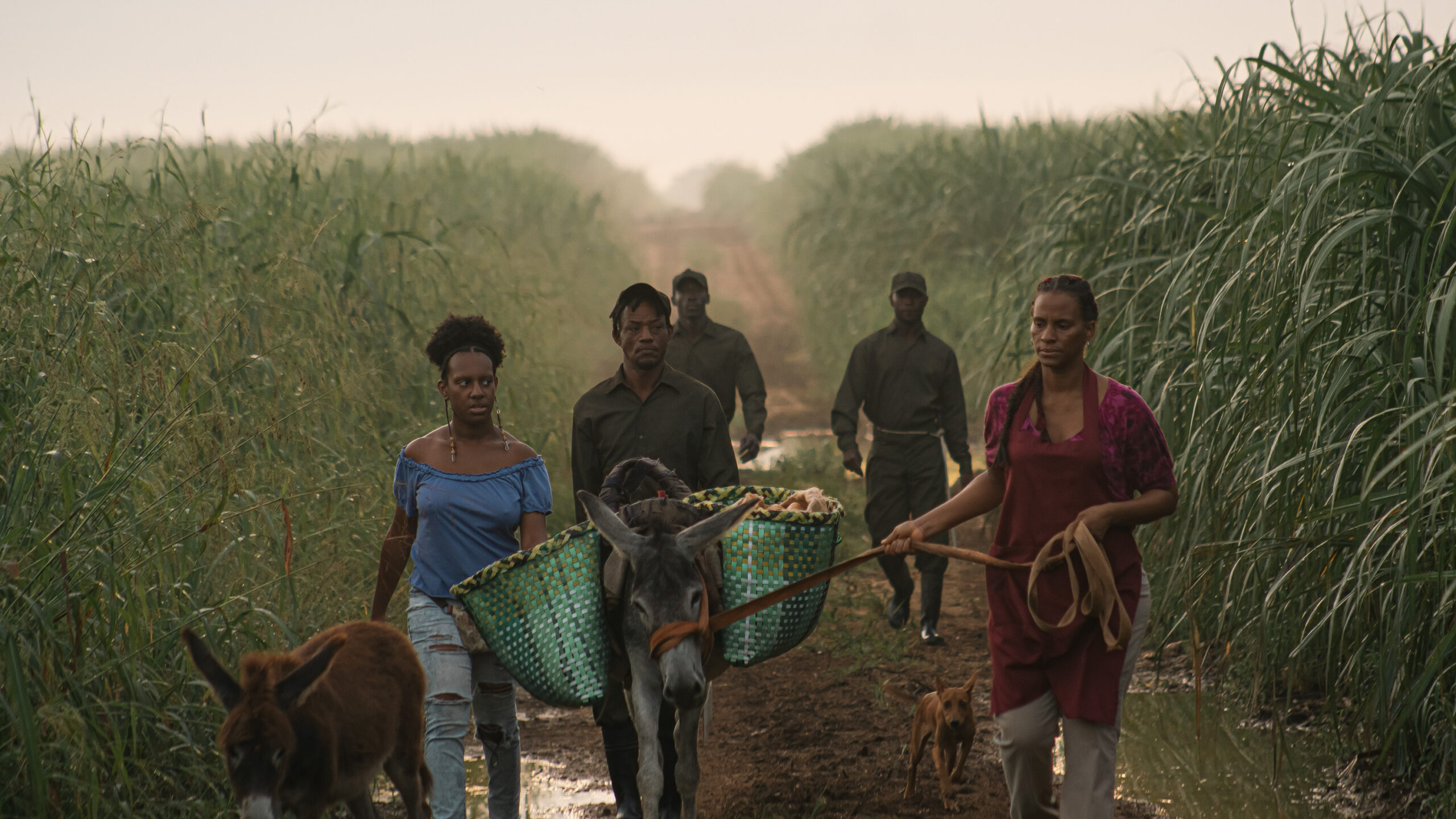
Sugar Island (2024)
Film by Johanné Gómez Terrero
91 minutes | Spain, Dominican Republic | Haitian and Spanish with English subtitles
Presented with:
U of T Community Engaged Learning Program (New College), the Latin American and Caribbean Solidarity Network, the Centre for Caribbean Studies, and the Caribbean Solidarity Network
Date:
Friday May 22, 2026
7:00 – 9:30pm
Location:
First Unitarian Congregation of Toronto
473 Oakwood Ave, York, ON M6C 2R5
Open in Google Maps
Accessible venue, more info here
 Sugar Island immerses us in the Dominican Republic’s sugarcane fields, where Makenya, a Dominican-Haitian teenager, navigates an unexpected pregnancy and the harsh labor that defines her world.
The screening was to be followed by a panel discussion that unfortunately needed to be postponed.
Register for the re-screening and discussion here.
Johanné Gómez Terrero is an Afro-diasporic artist who positions her work within a Caribbean and decolonial framework. Her emergence as a director was marked with her short documentary ‘Caribbean Fantasy’. Through her work as a director, producer, consultant and teacher, she explores Complex Thinking, Anti-Racist Struggle, and Marronage Cinema. Johanné is a graduate and educator at EICTV Cuba, where she also serves as chair coordinator, and holds a Master’s degree from ESCAC in Spain.
Magdalee Brunache is a Haitian Researcher and a PhD student in Political Science at the University of Toronto and a collaborative student at the Women and Gender Studies Institute. She holds an MSc in Rural Development from Ghent University (Belgium), and a BSc in Agribusiness from National Chung Hsing University (Taiwan). She is a Blumenfeld Junior Fellow at Science for Peace. Her research examines how violence, sovereignty, gender, and collective identity intersect in postcolonial Haiti. Magdalee has presented her work at international conferences, including the Haitian Studies Association, Canadian Association of African Studies and SASE, and published on topics ranging from food systems to Haitian political culture. She is the founder of RÈG Ayiti, a non-profit organization advancing menstrual health, sexual and reproductive rights, and youth-led feminist initiatives in Haiti. Her work bridges academic research, community practice, and transnational activism.
The Caribbean Solidarity Network (CSN) is an organization committed to the principles of Caribbean Liberation and Unity across the region as well as throughout the Diaspora. CSN’s platform is one rooted in a feminist, anti-imperialist, anti-colonial struggle. The history of the Caribbean peoples has always been one of freedom and self-determination. CSN offers space for the Caribbean community and invested allies to foment ideas and build collective knowledge and understanding about present and local circumstances.
The University of Toronto New College’s Community Engaged Learning is a placement-based program for students to work in social service or community sector.
Caribbean Studies at the University of Toronto is an interdisciplinary program engaging Caribbean history and society, politics and economic development, literature and thought.
The Latin American and Caribbean Solidarity Network (LACSN) is a democratic, non-profit and independent organization based in Toronto, Canada. It brings together various grassroots groups, networks and organizations that carry out work in solidarity with progressive and democratic transformation processes taking place in Latin America and the Caribbean.