
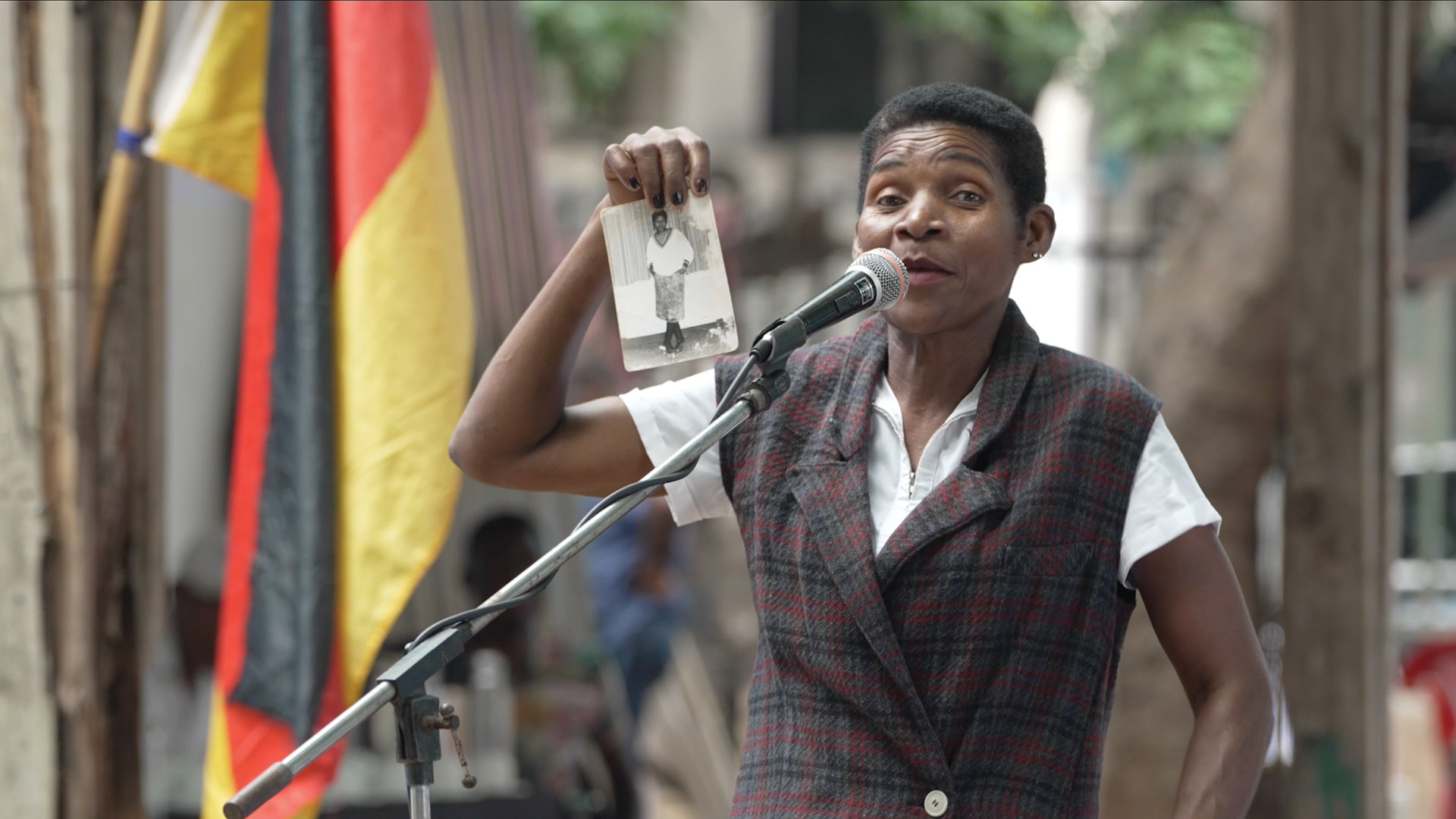
Rendition
A Cinematic Essay by Euridice Zaituna Kala
Presented in collaboration with:
Charles Street Video
Thanks to CSV for supporting this exhibition through their Maker Space program.

Artist Talk:
Saturday May 23,
1:00–3:00pm
Extended Gallery Hours
Sunday May 24,
10:00am–5:00pm
Exhibition dates:
May 2 – 30
Wednesdays 12:00-4:00pm
Thursday & Friday, 6:00-8:00pm
Saturday 1:00-4:00pm
Presented as a part of:
Every Worker Should Have Equal Labour Rights
Location:
Charles Street Video
76 Geary Ave, Toronto, ON M6H 2B5
Open in Google Maps
Venue is accessible, more info here
Rendition is a hybrid cinematic essay that questions the documentation of “history in the mak-ing” by assembling a mosaic of materials-from personal memories and interviews to ongoing protest documentation-to tell the story of the Madgermans.
In 1979, 15,000 Mozambicans emigrated to East Germany (GDR) as contract workers, only to be abruptly sent back to Maputo after the reunification of Germany in 1989. Returning with a wave of Western gadgets that briefly flooded the popular imagination, these workers were left waiting for the balance of their contracts to be paid by a new, democratic Mozambican government (FRELIMO).
Disillusioned by this historical debt and governmental apathy, the Madgermans—a contraction of “Made in Germany”—transformed their political plight into a decades-long public demonstration. They famously appropriated the “Garden of May 28” in Maputo, renaming it the “Madgermans’ garden,” turning a public space into a powerful, permanent political forum. Over time, their protest has evolved into a broader denunciation of national corruption, positioning them as key figures of modern Mozambican dissent.
Despite dwindling numbers due to illness and death, their cause remains suspended in time, revealing the enduring legacy of unfulfilled promises and the failure of international and local governments to address a profound historical partition.
The film’s context is rooted in the complex geopolitical and socio-economic consequences of the Cold War’s end, specifically concerning contract labor migration between the People’s Republic of Mozambique (PRM) and the German Democratic Republic (GDR).
Historical Foundation (1979-1989): The movement of 15,000 Mozambican workers to the GDR was part of a bilateral agreement between two socialist states. These contracts were essential for the GDR’s labor force and were meant to provide Mozambique with foreign currency and skilled workers.
A significant portion of the workers’ wages were withheld and meant to be paid upon theirreturn to Maputo- a debt that became the core of the Madgerman conflict.
The fall of the Berlin Wall (1989-1990s) and German reunification dissolved the GDR’s contractual obligations. The subsequent burden fell to the new FRELIMO government in Mozambique, which, emerging from a devastating civil war, failed to secure or honour the payments. This breach of contract created a generation of “returnees” facing economic hardship and marginalization. The Madgermans’ protest is a symbolic and literal reclaiming of space. Their decades-long occupation of a public garden in Maputo highlights the transformation of public life in post-civil-war Mozambique. Their sustained activism underscores a deep disillusionment with the new democratic government, shifting their demand from not only wages to broader anti-corruption calls. The establishment of the Centro Cultural Moçambicano-Alemão (2017) by the German government serves as a cultural attempt to address this historical liability—a form of soft power and cultural diplomacy aimed at creating an “apolitical platform” for a deeply political issue. The film interrogates this complex rendering of historical justice and cultural exchange.
Thematic Core: The film questions how a state’s broken promise can define the identity and political action of a marginalized group for over three decades, revealing a story of suspended citizenship and the human cost of global political transitions.
Euridice Zaituna Kala
Born in 1987 in Maputo, Mozambique, Euridice Zaituna Kala lives and works in Maisons-Alfort. Her work focuses on cultural and historical metamorphoses, their manipulations and their ad- aptations. The artist reproduces the visual vocabulary of historical archives in order to reveal not only their subjectivity, but also those they have invisibilized. She questions the appropriation of black bodies through their representation in archives; but rather than seizing their history, she attempts to reaffirm their existence. Her approach is based on research, with a multi-form expression. Her practice is protean: performances, installations, photographs, texts, videos, sculptures/landscapes, sound pieces. A graduate in experimental photography from the Market Photo Workshop in Johannesburg (South Africa) in 2012 and from the Asiko School in Maputo (Mozambique) in 2015, currently enrolled in a Masters of Arts programme at the École national supérieure d’arts Paris-Cergy (2026). Euridice Zaituna Kala is the first laureate of the Prix Carta Bianca (2025-2026), a finalist for Paulo Cunha e Silva prize (2023). She was also the recipient of the Villa Vassilieff/ADAGP scholarship (2019/2020) and did a residency at the Villa Albertine in New York (2022/2023) and at the Villa Medici in Roma (2023). Zaituna Kala has presented a solo exhibitions such as Daylighting: mais c’est l’eau qui parle, La Criée Rennes (2025), La Loge, Brussels (2026), Kunsthalle, Münster, (2026), En quelques gestes: as if two suns were setting, Galerie Anne Barrault, Paris (2025), Sea(E)scape: Dna (Don’t (N)ever Ask), Salon H, Paris , (2022), and Je suis l’archive, I the archive at Villa Vassilieff in Paris (2020). She also participates in many group shows, such Le Syndrome de Bonnard, Frac Ile-de-France, Paris & Romainville, (2026) The Great Camouflage, Rockbund Art Mu- seum, Shanghaï, China (2025-2026) Primavera, Primavera, Frac MÉCA, Bordeaux (2024), Echos der Bruderländer at the HKW in Berlin and Passengers in Transit in the frame of the Ven- ice Biennale, Prémio Paulo Cunha e Silva, at Porto Municipal gallery (2023), Indigo Waves and Other Stories at Berlin Savvy Contemporary gallery (2023), Fata Morgana at the Jeu de Paume in Paris (2022), This is Not Africa – Unlearn What You Have Learned at the ARoS Museum in Aarhus Denmark (2021), Le pouvoir du dedans at the Galerie, Centre d’Art Contemporain in Noisy-le-Sec (2018). Future Performances inlcude: Trou Noir, et Compositions at La Loge, Brussels (2026), She has presented numerous performances including Sea(E)scapes: Listening Session at the Jeu de Paume (2022), Toetra (based on the text Je suis l’archive ) at the Centre Pompidou (2021), Stranger, Danger : Wait, it’s just a prayer Room at the Centre Pompidou (2019), and Mackandal Turns into a Butterfly: a love portion at the Galerie, Centre d’Art Contemporain in Noisy-Le-Sec (2018). She is an artist-teacher at the École des Beaux Arts of Nantes. She is also the founder and co-organizer of e.a.s.t. (Ephemeral Archival Station), a laboratory and a platform for artistic projects and research, founded in 2017.
Charles Street Video (CSV) is a non-profit production organization dedicated to supporting media artists. CSV fosters the creation of media art, encourages experimentation, and develops an artistic community in Toronto. CSV is the city’s leading media arts production centre where emerging and established artists gather to achieve their artistic visions. CSV provides affordable access to equipment and post-production editing facilities for creating videos, films, installations and other media art forms. They also commissions artists to create new works, and sponsors a variety of youth-oriented production programs and post-secondary scholarships. CSV actively participates in local exhibitions of media art through partnerships with arts organizations and grassroots festivals.