Condé Beveridge Labour Arts Residency
In memory of Carole Condé
History
Carole Condé (June 27, 1940 – July 19, 2024) will be remembered for her dedication to building an art practice centred around revolutionary social change. Her work responded to critical and contemporary cultural, social, and political issues. She rejected the elite capitalist artworld and brought representations of working people to art made with and for the people.
Along with long-time collaborator and partner, Karl Beveridge, they created a significant body of work, spanning over fifty years. Their work involved collaboration with union members and spoke to issues of labour justice. They have exhibited internationally and been recognized for their significant artistic contributions. Condé and Beveridge have been leaders in the field of labour arts in Canada and are founding members of both the Mayworks Festival of Working People and the Arts and the Workers Arts and Heritage Centre in Hamilton.
To learn about their work read this article in POV magazine by Vincenzo Pietropaolo.
The Residency
The residency program seeks to embody: the spirit of collaboration; the commitment to labour movements and social analysis; the influence of artistic genres; and the public accessibility that is found in their practice.
All genres are welcome including theatre, dance, visual art, media arts, music and multi-disciplinary.
Taking place over two years, the residency offers an artist or an artist group:
- Funding for participation in the residency program
- Funding to cover research and creation expenses
- Two sessions with Karl Beveridge
- Mentorship with an experienced labour artist
- Collaboration with a relevant labour union and/or union members
- Presentation in the Mayworks festival
- Funding for festival participation
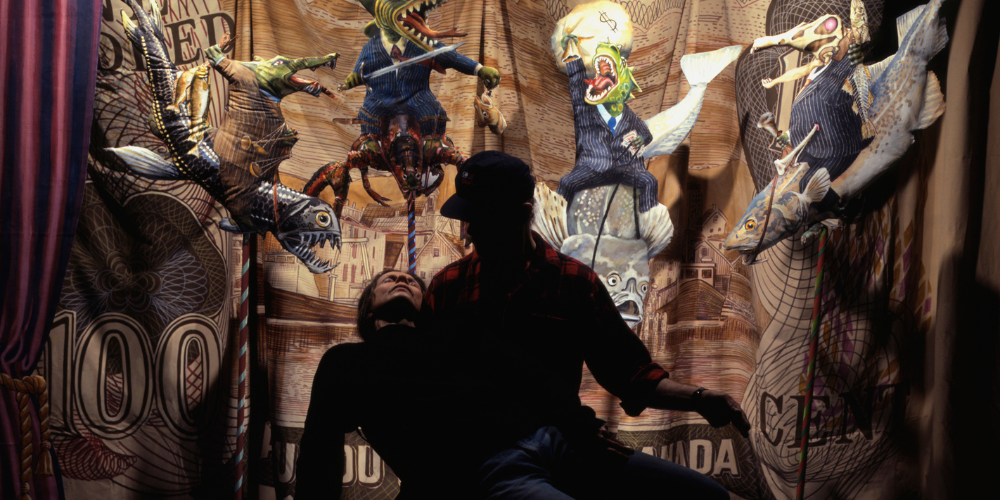
“Non Habera nada para ninguen” or “There Will Be Nothing for Anyone” tells the story of the decline of the cod fishery in Vigo, Spain, from a Canadian perspective. Developed in collaboration with members of the Fish, Food and Allied Workers Union (FFAW/CAW). Carole Condé and Karl Beveridge, 1994.
Program Details
Eligibility
Artists who are Canadian citizens or permanent residents or those waiting for permanent residency are welcome to apply.
Artist Fees
- Artists will receive $4,000 to participate in the program.
- Artist groups of two or more will receive $6,000.
- Artists will receive a minimum fee of $1,000 to present their work in the festival.*
*While the program is designed to create art for the festival, final programming decisions rest with the Mayworks programming committee.
Project Expenses
Artists will receive up to $1,000 to cover research and creation expenses, however if costs exceed this amount, the artist is expected to cover these expenses. Mayworks will seek to raise funds to help artists offset creation costs, but this funding is not guaranteed. Mayworks will work with the artist to apply for project grants.
Mentorship
Mentorship includes up to 6 two hour sessions. Both Mayworks and the artist may recommend potential mentors. Mayworks will need to approve the final selection.
Collaboration
Based on the artists’ concept, Mayworks will work with the artist to bring a union or union members on board to participate as collaborators.
Sessions with Karl Beveridge
The artist will meet with Karl Beveridge twice over the two year residency. Once at the beginning for an orientation session and then later for further conversation about the project’s development.
Location
Project development including meetings and mentorship may be done remotely. Installation, implementation and presentation including artist talks or other accompanying programming requires artists to be in the Toronto area.
Selection
Artists will be selected by an independent jury made up of cultural workers and union members based on materials submitted by the artist during the submission process.
Timeline
February 25, 2026: Call for submissions opens
March 24, 6:00PM: Submission Q&A with Mayworks on zoom: Join here.
April 19, 2026: Deadline to apply
June 8, 2026: Selected artist notified
June 11, 2026: Orientation meeting with Mayworks staff
June 22, 2026: Meeting with Karl Beveridge
June 2026–April 2028: Meetings, mentorship, research, creation
September 8, 2026: Development plan due and meeting with Mayworks
Project update meetings with Mayworks every 2–3 months
February 1st, 2028: Installation/presentation plan due and meeting with Mayworks
February 25, 2028: Project draft/samples complete
March 1, 2028: Festival promotion documentation due
April 1, 2028: Final project complete
June 12, 2028: Final report submitted to Mayworks
Submission Process
Please submit your application by April 19, 2026. Artists are expected to have learned more about the work of Carol Condé and Karl Beveridge before completing their application. To learn more about their work visit their website, and read this article in POV Magazine by Vincenzo Pietropaolo.
To submit your application, send your resume and the answers to questions 2–9 as one single pdf document to submissions@mayworks.ca.
1. Resume
2. Bio (max 250 words) – a description of your artistic practice and any other information about you that you would like to share and that is relevant to this residency
3. Samples of your previous work — please send links to up to five samples
4. What do you propose to develop and create for presentation at Mayworks 2027? (Max 500 words. Note that it is understood that projects shift over time but explain what you have in mind now and how you would like the project to evolve.)
5. How does your project include collaboration with union members? (max 200 words)
6. How does your project demonstrate a commitment to labour movements and social analysis? (max 200 words)
7. How does your project incorporate an openness to or the influence of other artistic genres? (max 200 words)
8. How is your project accessible to the public? (max 200 words)
9. Work Plan describing how you will develop the project over the two-year period. (max 250 words)
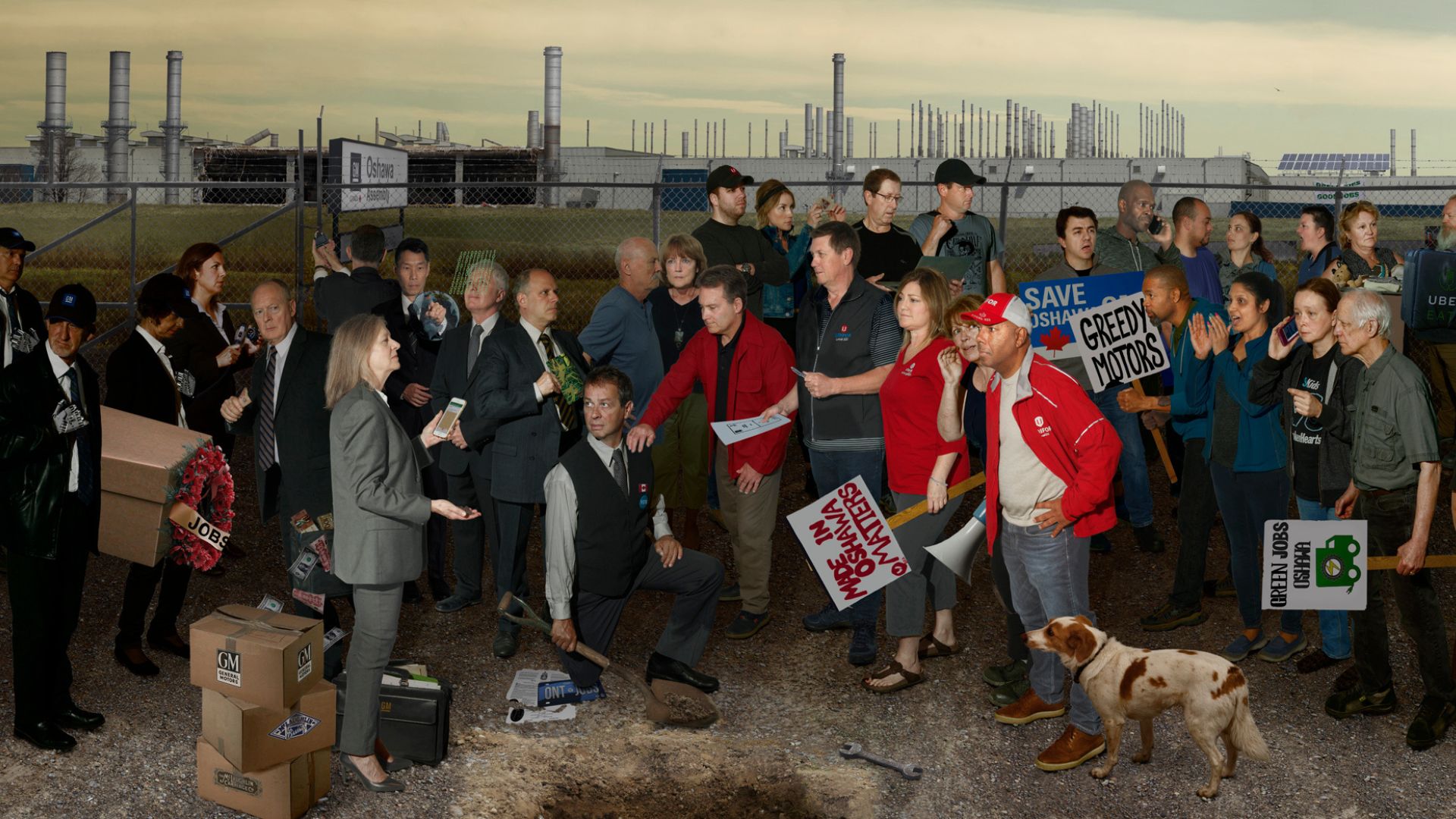
“Burial at Oshawa” speaks to the 20,500 workers who have been slowly laid-off for the past 35 years as product lines were shut down, jobs transferred to independent contractors, and automation took over jobs. The closing down in 2019 is the end of a slow death not only of the plant but of an industrial era and it’s working class culture. Members of Local 222 play themselves in the image. Carole Condé and Karl Beveridge, 2019.